
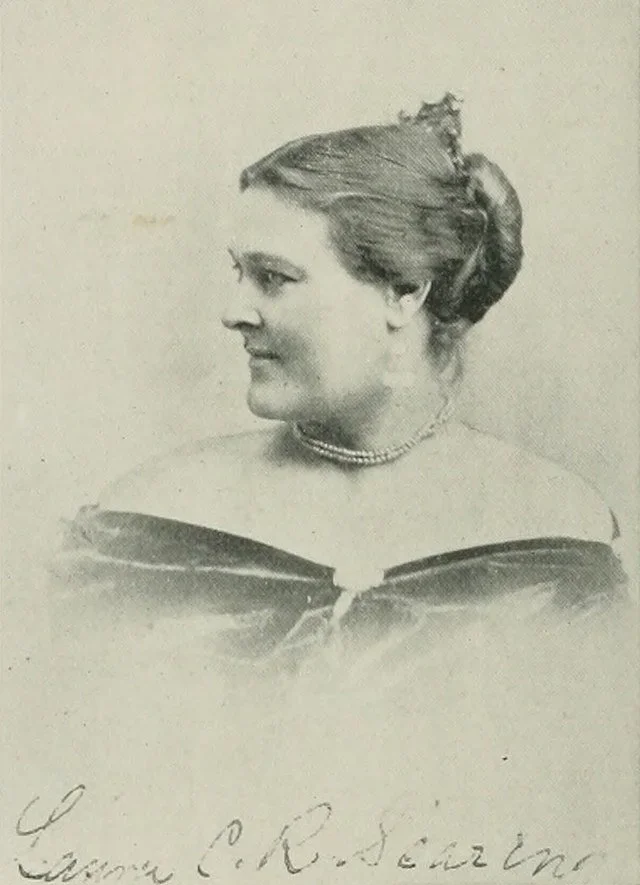
Laura Redden Searing
Also found under Poetry, Nonfiction, Writers with Disabilities
Who Was She?
Laura Redden Searing was born in 1839 in Maryland. At the age of 11, she became deaf after contracting meningitis. From 1857-1858, she submitted poems to Harper's Magazine, and in 1858, the American Annals of the Deaf professional journal published her first essay, written on the topics of deaf culture, sign language, and writing. That same year, she graduated from the Missouri School for the Deaf, but was unable to attend college, since no colleges accepted deaf women at the time. Throughout her life, critics doubted her ability to write poetry, questioning how she could know anything about rhyme or rhythm. In spite of the criticism, Searing wrote more than 70 poems and also pursued a career as a journalist. In 1859, she was hired as a columnist at the St. Louis Presbyterian, and went on to become the editorialist for the St. Louis Republican in 1860, where she officially adopted the pseudonym Howard Glyndon. In 1861, the Republican sent her to Washington, D.C. to cover the American Civil War. She documented the war from a pro-Union perspective, and wrote poetry about the intimately human side of events on the battlefield. She also wrote letters to both Abraham Lincoln and Ulysses S. Grant. Her first book of poetry, Idyls of Battle, and Poems of the Rebellion was published in 1864, and from 1865 to 1869, she embarked on a tour of Europe, working as a foreign correspondent for the New York Times and learning German, French, Spanish, and Italian. In 1870, she returned to the U.S., taking a job as a staff writer for the New York Evening Mail and contributing to such publications as Galaxy, Harper’s Magazine, and the Tribune. In 1872, the town of Glyndon, Minnesota was named in her honor. Today, many believe her to be the first deaf female journalist.
What Did She Write About?
Culture & politics human interest stories, Deafness, Sign language, Writing
Where Can I Find Her Work?
Regret you? Not I! I am glad that your proud heart disowned me, The while it was lying so sullenly under my feet; Since Love was to you but a snare and a pain, and you knew not Its height and its depth, all unsounded, and soundless, and sweet.
-Excerpted from Corinna Confesses